Cayenne
When Porsche dared to do an SUV — and 911 fans were furious
In 2002, when Porsche announced it would build an SUV, the 911 faithful were horrified. To purists who believed Porsche should only build the 911, the Cayenne was heresy. It shared a platform with the Volkswagen Touareg, and was built in Bratislava, Slovakia. Yet what followed went in a direction no one predicted — the Cayenne saved Porsche.
The SUV that saved the company
22,000 units sold in the US in its 2003 launch year alone. The Cayenne took the title of best-selling single Porsche model away from the 911. Through to the 2008 financial crisis, it generated roughly 40 per cent of Porsche's revenue and effectively bankrolled R&D on the 911 and Boxster. The 957 facelift (2007) brought a 4.8-litre V8 twin-turbo; the Cayenne Turbo S, at 550 hp, opened the era of ‘V12-class torque in an SUV.’
A 911 in SUV form — the 958 and 9Y0
2010, the second-generation 958. The first aluminium-and-steel mixed body cut 185 kg. The first PHEV (S E-Hybrid) and diesel lined up. In 2018 the third-generation 9Y0 brought PASM, rear-wheel steering, an 8-speed Tiptronic S and an interior soaked in 911 design language. The positioning became official — if a 911 owner buys an SUV, the answer is the Cayenne.
Electrification — the fourth-generation E3
2026, the fourth-generation Cayenne Electric (E3). A PPE-platform BEV with an 800V architecture, launched alongside the ICE 9Y0 facelift. The car that ‘should never have been built’ became, 24 years later, the car that ‘had to be electrified’. A single SUV opened two eras for Porsche — the luxury SUV era, and the EV era.
When Porsche dared to do an SUV — and 911 fans were furious. In 2002, when Porsche announced it would build an SUV, the 911 faithful were horrified. To purists who believed Porsche should only build the 911, the Cayenne was heresy. It shared a platform with the Volkswagen Touareg, and was built in Bratislava, Slovakia. Yet what followed went in a direction no one predicted — the Cayenne saved Porsche. The SUV that saved the company. 22,000 units sold in the US in its 2003 launch year alone. The Cayenne took the title of best-selling single Porsche model away from the 911. Through to the 2008 financial crisis, it generated roughly 40 per cent of Porsche's revenue and effectively bankrolled R&D on the 911 and Boxster. The 957 facelift (2007) brought a 4.8-litre V8 twin-turbo; the Cayenne Turbo S, at 550 hp, opened the era of ‘V12-class torque in an SUV.’ A 911 in SUV form — the 958 and 9Y0. 2010, the second-generation 958. The first aluminium-and-steel mixed body cut 185 kg. The first PHEV (S E-Hybrid) and diesel lined up. In 2018 the third-generation 9Y0 brought PASM, rear-wheel steering, an 8-speed Tiptronic S and an interior soaked in 911 design language. The positioning became official — if a 911 owner buys an SUV, the answer is the Cayenne. Electrification — the fourth-generation E3. 2026, the fourth-generation Cayenne Electric (E3). A PPE-platform BEV with an 800V architecture, launched alongside the ICE 9Y0 facelift. The car that ‘should never have been built’ became, 24 years later, the car that ‘had to be electrified’. A single SUV opened two eras for Porsche — the luxury SUV era, and the EV era.
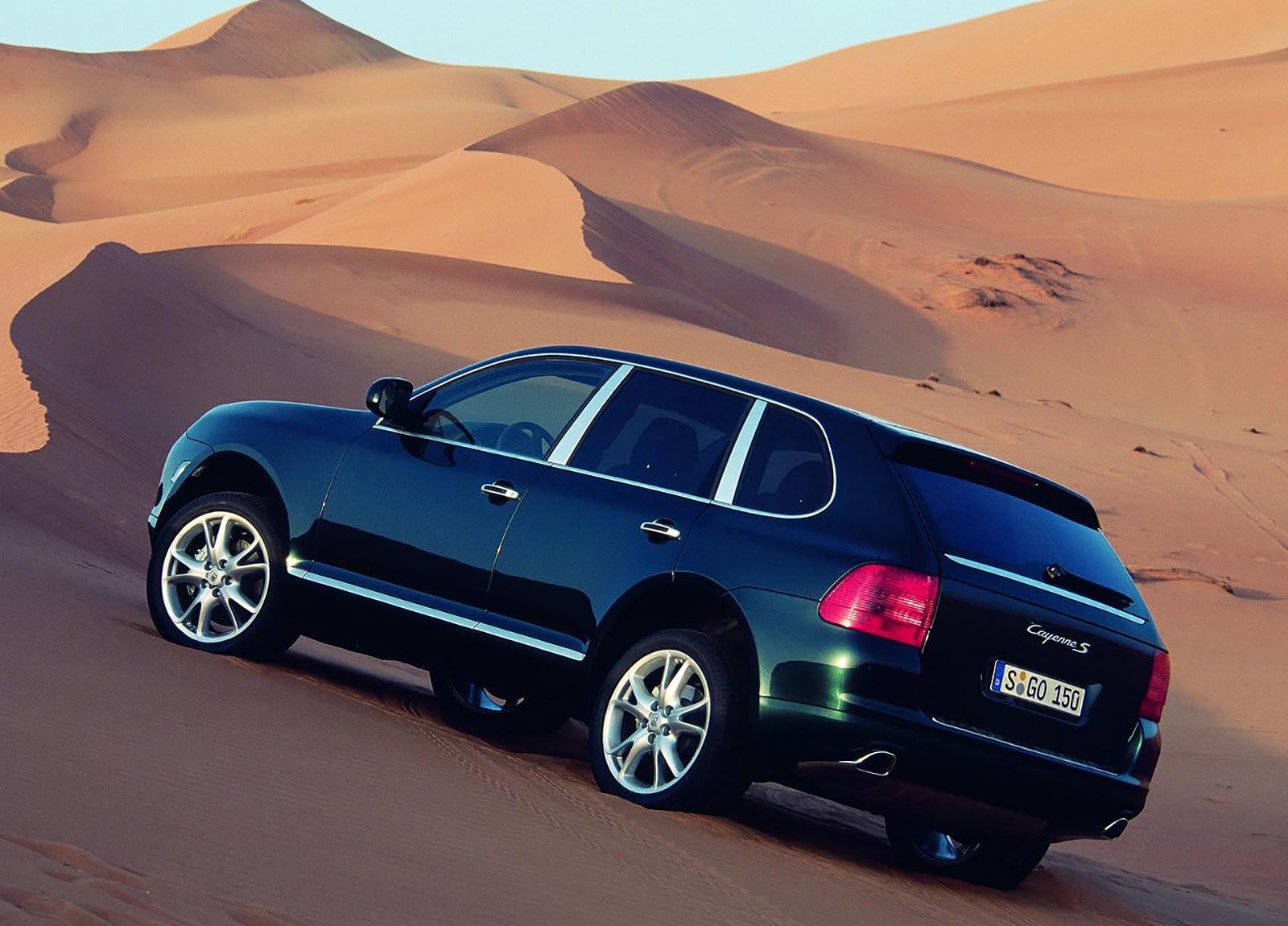
Cayenne (955/957)
First generation (955/957, 2002-2010). Platform and production line shared with the Volkswagen Touareg, built in Bratislava, Slovakia. At launch the 911 faithful called it a betrayal — but 22,000 US sales in year one immediately made it Porsche's best-selling single model. The 957 facelift in 2007 added a 4.8-litre V8 in natural-aspirated and twin-turbo form — the Turbo S making 550 hp. The car that saved the company.
- LaunchFirst-generation Cayenne launches — Paris Motor Show, 2002September 2002, Paris Motor Show — the first-generation Cayenne (955) makes its debut. Sharing the PL71 platform with the Volkswagen Touareg, built in Bratislava, Slovakia. 911 fans called it a betrayal, but the order book stretched out from launch day. V8 4.5-litre natural-aspirated 340 hp (S), and twin-turbo 450 hp (Turbo).Wikipedia (Cayenne) ↗
- Milestone22,000 US sales in the first year — Porsche's best-selling single modelIn 2003 the Cayenne sold 22,000 units in its first US year — roughly triple the 911's US figure that year (around 8,000). Porsche's best-selling single model title shifted from the 911 to the Cayenne, and the SUV would go on to generate roughly 40 per cent of company revenue. ‘The car that saved Porsche’ takes shape.Wikipedia (Cayenne) ↗
- MilestoneCayenne Turbo S launches — 521 hp, first generationIn 2006 the Cayenne Turbo S launched — 4.5-litre V8 twin-turbo, 521 hp and 720 Nm. It comfortably outpaced the contemporary BMW X5 4.8is (360 hp) and Mercedes ML 63 AMG (510 hp), and effectively defined the modern high-performance SUV category. The Cayenne had opened a path to becoming ‘the mad SUV’.Wikipedia (Cayenne) ↗
- F/L957 facelift — 4.8-litre V8, direct injection arrivesIn 2007 the 957 facelift arrived — refreshed headlamps, bumpers and interior, plus an all-new 4.8-litre V8 with direct injection. Natural-aspirated 385 hp in the S, twin-turbo 500 hp in the Turbo, and 550 hp in the Turbo S. In eight years, output rose by 60 hp and torque by 100 Nm. The 957 was the generation when the Cayenne began to be talked about as a performance car worthy of comparison with the 911.Wikipedia (Cayenne 957) ↗
- MilestoneCayenne Diesel — Porsche's first dieselNovember 2008, the Cayenne Diesel launched. A Volkswagen Group 3.0-litre V6 TDI produced 240 hp and 550 Nm. The first diesel Porsche since the company was founded in 1948 — ‘a sports-car company building a diesel?’ — drew predictable criticism, yet it went on to take roughly 40 per cent of European Cayenne sales and remained core to the line-up until the 2015 Dieselgate scandal.Wikipedia (Cayenne Diesel) ↗
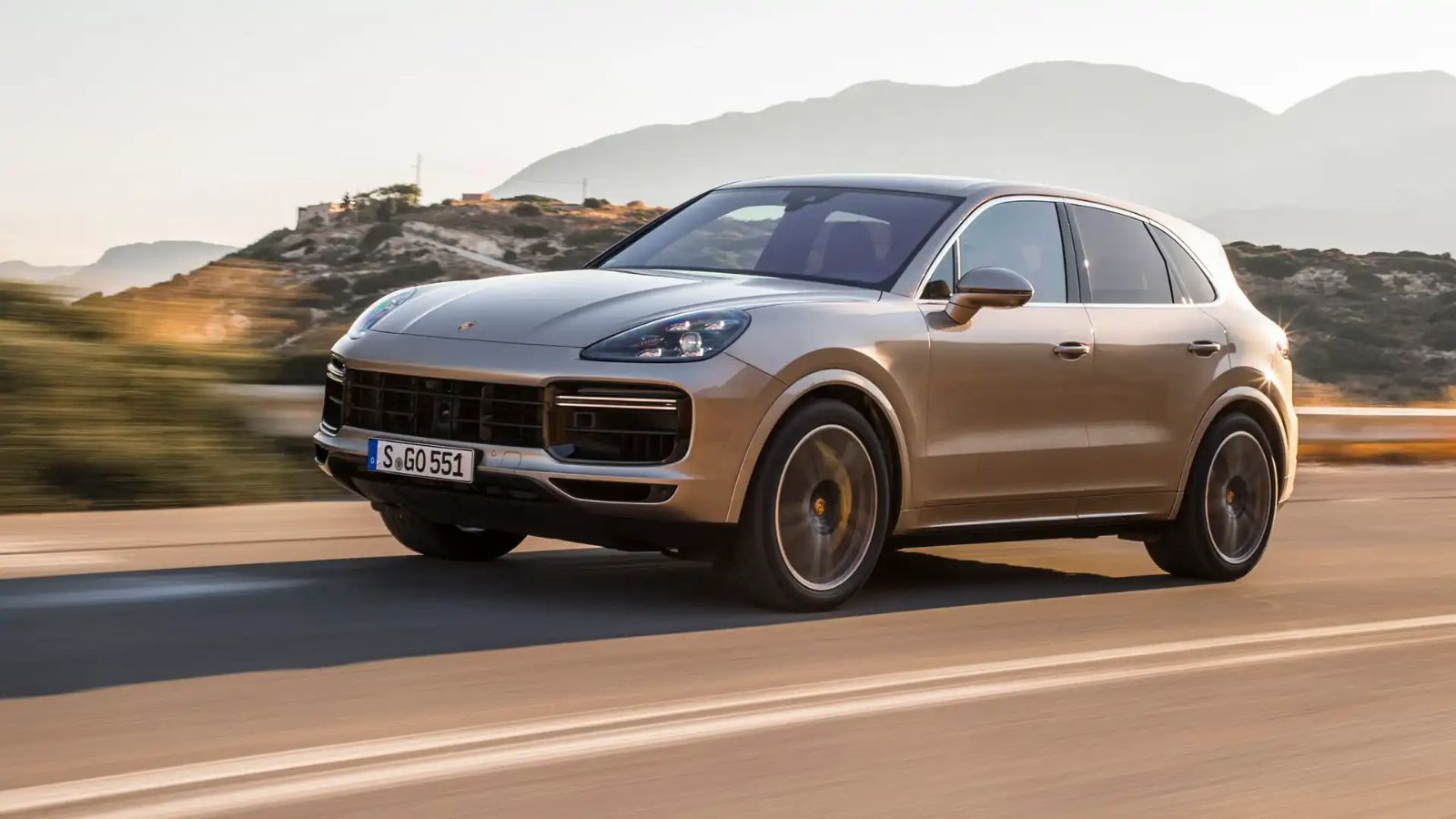
Cayenne (958)
Second generation (958, 2010-2018). Moved to the MLB platform, with a mixed aluminium-steel body that cut 185 kg. The first S E-Hybrid PHEV arrived in 2014 (416 hp), the diesel range expanded, and the 8-speed Tiptronic S replaced the old auto. The 2015 Dieselgate scandal killed the US diesel range, but globally the 958 era opened the Cayenne to a full multi-powertrain line-up.
- LaunchSecond-generation 958 launches — aluminium arrives, 185 kg lighterMarch 2010, Geneva Motor Show — the second-generation Cayenne (958) makes its debut. MLB platform, aluminium-steel mixed body, 185 kg lighter than the first generation. The new 8-speed Tiptronic S, stop-start as standard. The styling was the first SUV interpretation of the design language launched by the 911 991 — pulled-down headlamps and sharper surfaces.Wikipedia (Cayenne 958) ↗
- LaunchCayenne S E-Hybrid — Porsche's first PHEVIn 2014 the Cayenne S E-Hybrid launched. A 3.0-litre supercharged V6, 95 kW motor and 10.8 kWh battery combined for 416 hp. Porsche's first production PHEV since the company's founding in 1948 — the starting point for the Cayenne and Panamera PHEV ranges, and the first step on the road that leads through to the Taycan and the EV Macan.Wikipedia (Cayenne S E-Hybrid) ↗
- RecallDieselgate — US Cayenne Diesel sales haltedOn 18 September 2015 the EPA announced the Volkswagen Group diesel emissions scandal. The Cayenne Diesel (3.0-litre V6 TDI) used the same engine and US sales were halted that November. In November 2016 a settlement with the US EPA triggered a buyback and recall programme for first- and second-generation diesel Cayennes. The global diesel range was retired in 2018.Wikipedia (Dieselgate) ↗
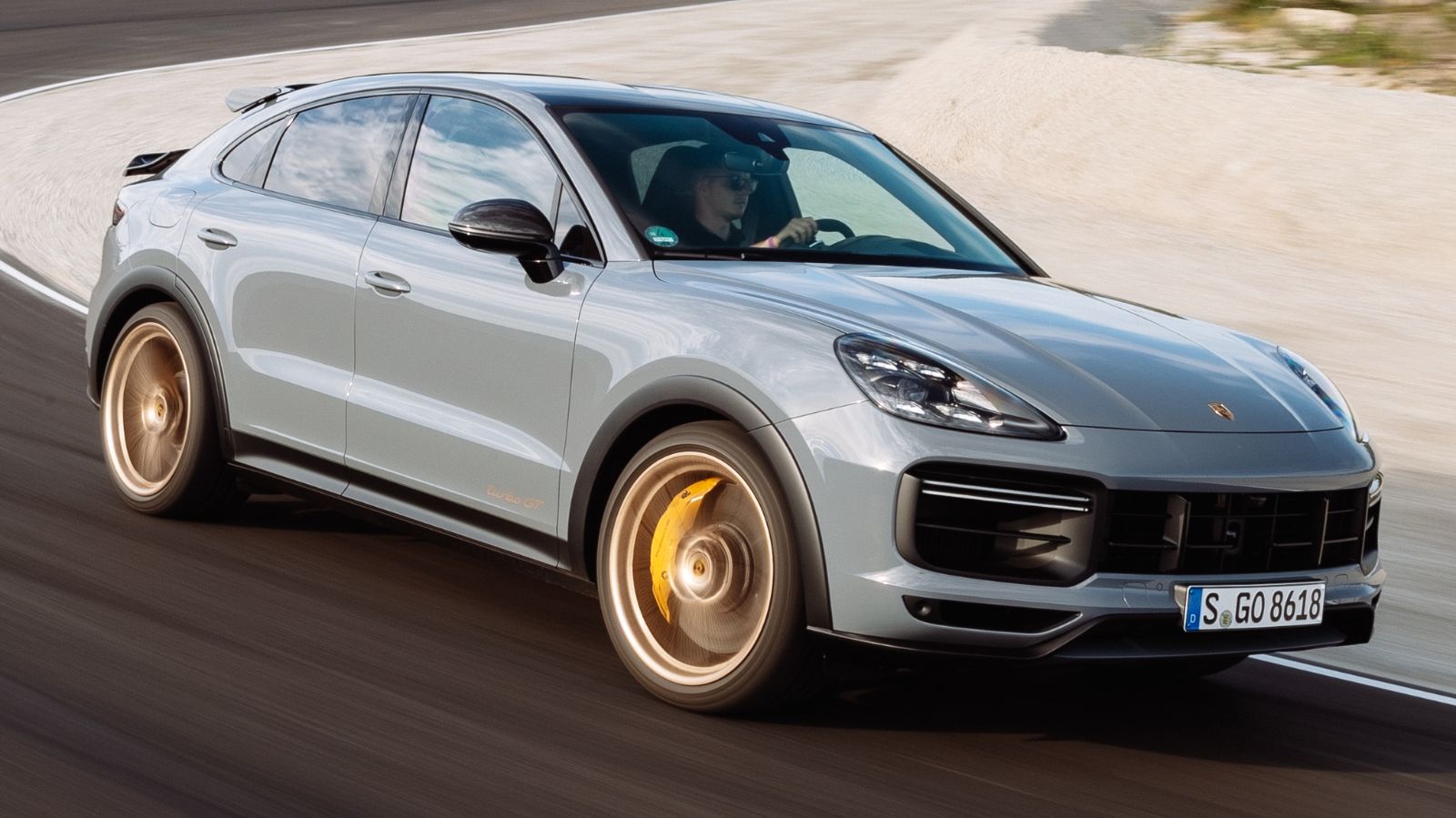
Cayenne
Third generation (9Y0, 2018-2023). MLB Evo platform, with rear-wheel steering for the first time and PASM adaptive suspension. The interior absorbed the 911's design language — a full digital 12.3-inch infotainment screen flanking an analogue rev counter. The Cayenne Coupé split off as a separate body style in 2019. ‘If a 911 owner buys an SUV, it's a Cayenne’ — the positioning was completed with this generation.
- LaunchThird-generation 9Y0 unveiled — rear-wheel steering, 911-style cabinOn 29 August 2017 in Stuttgart, the third-generation Cayenne (9Y0) was unveiled. MLB Evo platform, with rear-wheel steering for the first time (up to 3 degrees) and PASM adaptive suspension as standard. The interior brought the 911's design language into the SUV — a 12.3-inch full digital infotainment screen and a five-pod cluster with an analogue rev counter in the centre.Porsche Official ↗
- LaunchCayenne Coupé — the first coupé-bodied CayenneIn March 2019 the Cayenne Coupé launched — a 9Y0-based variant with a roofline 20 mm lower and a more steeply raked rear. Carbon roof as an option, with an adaptive rear spoiler. The car put Porsche directly into the ‘coupé SUV’ category dominated by the BMW X6 and Mercedes GLE Coupé.Porsche Official ↗
- LaunchCayenne Turbo GT — 631 hp, the most powerful Cayenne yetIn August 2021 the Cayenne Turbo GT launched — 4.0-litre V8 twin-turbo, 631 hp and 850 Nm, 0-100 km/h in 3.3 seconds, a top speed of 300 km/h. Cayenne Coupé only. Its Nürburgring SUV lap of 7 minutes 38.9 seconds was, at launch, the production-SUV world record. The Cayenne had reached SUV-supercar territory.Porsche Official ↗
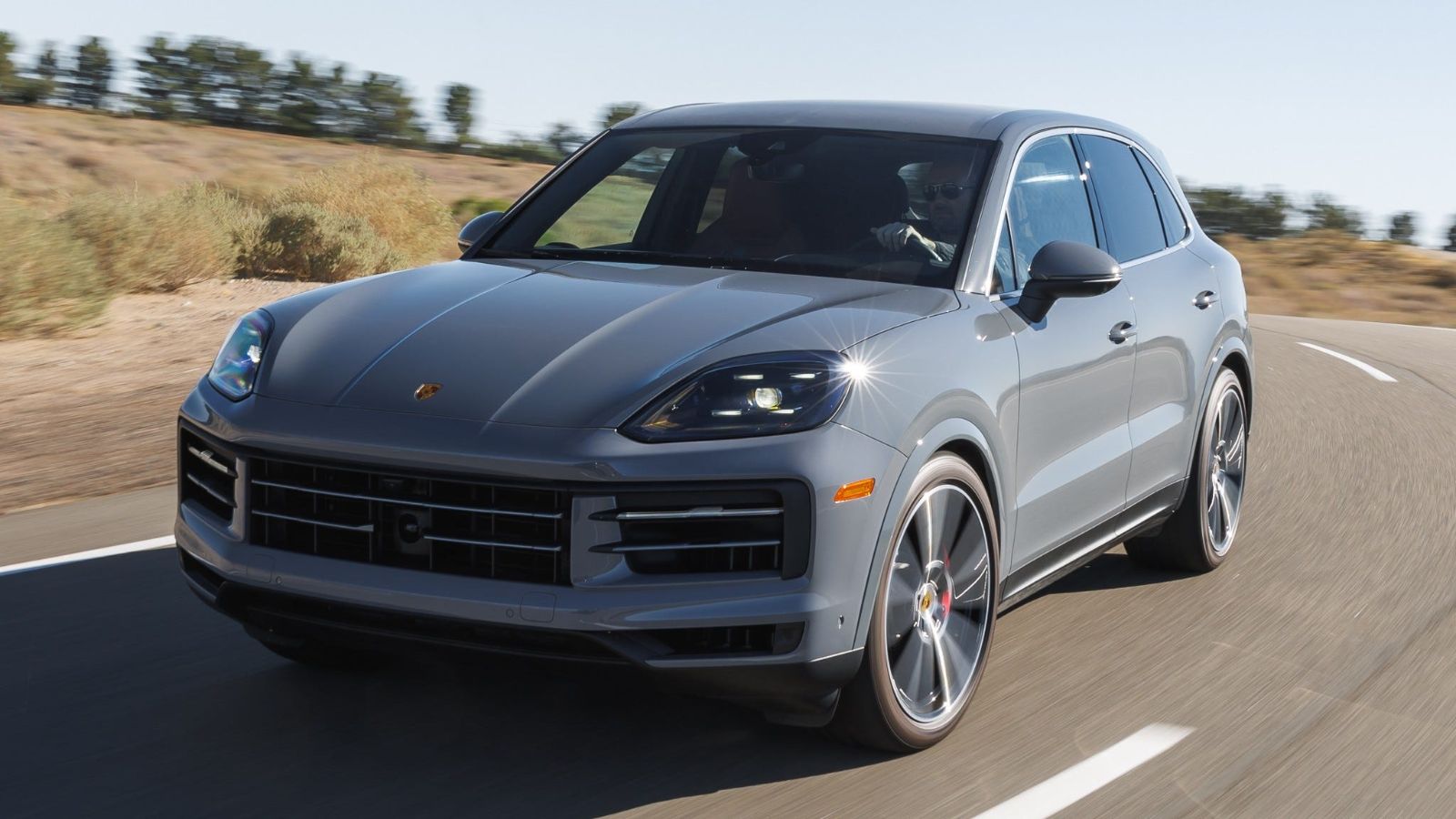
Cayenne
Third-generation facelift (9Y0 FL, 2023-). New headlamps and bumpers, with an interior overhaul that amounts to a generational change — a full digital cluster and the addition of a passenger-side display. In 2024 the Cayenne Turbo GT's 4.0-litre V8 twin-turbo gained 50 hp for a total of 656 hp. This is the ICE line-up that sells alongside the fourth-generation Cayenne Electric — confirmation that the ICE Cayenne is not going away in the EV era.
- F/L9Y0 facelift — an interior overhaul to rival a full generation changeOn 18 April 2023 at the Shanghai Motor Show, the 9Y0 facelift was unveiled. The exterior update was minimal, but the cabin received what amounted to a generational change — a fully digital 12.6-inch curved cluster, a 12.3-inch infotainment screen and an optional 10.9-inch passenger display. Petrol, PHEV and V8 twin-turbo line-ups remained; diesel was retired globally. A car whose interior generation change arrived before its exterior did.Porsche Official ↗
- LaunchCayenne Turbo E-Hybrid — 739 hp, the most powerful Cayenne everIn 2024 the Cayenne Turbo E-Hybrid launched. A 4.0-litre V8 twin-turbo, 130 kW motor and 25.9 kWh battery combined for 739 hp and 950 Nm — the most powerful Cayenne in history. WLTP electric-only range of around 80 km. The car that shifted PHEV from ‘a fuel-economy aid’ to ‘a performance multiplier’.Porsche Official ↗
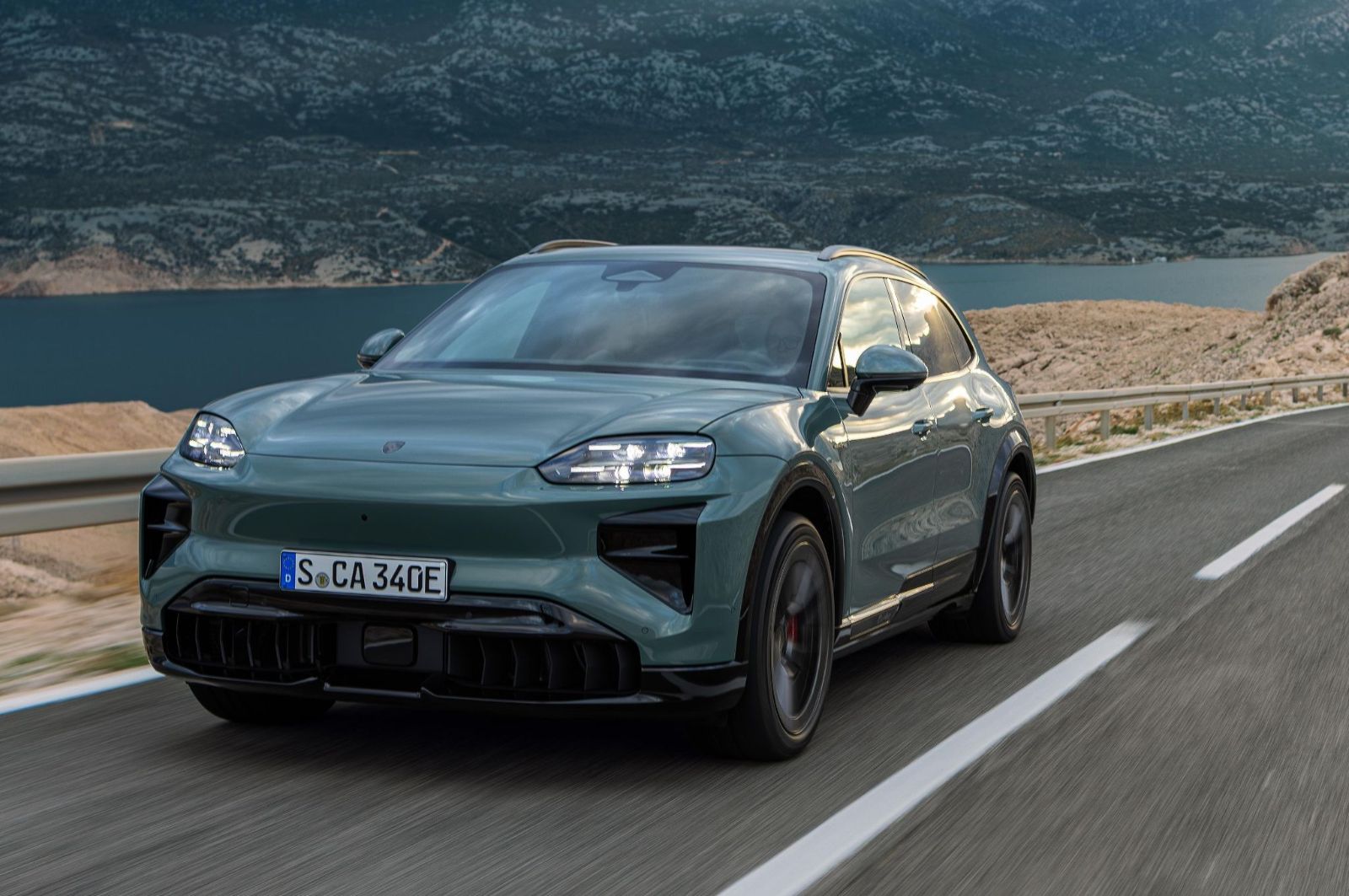
Cayenne Electric
Fourth-generation Cayenne Electric (E3, 2026-). The first BEV Cayenne, on the new PPE platform. 800V architecture, peak output around 800 kW (roughly 1,000 hp expected) and a WLTP target north of 600 km. Sold in parallel with the 9Y0 facelift, this is the ‘ICE and EV dual track’ — repeating in SUV form what Porsche already did with the 911 (992 GTS T-Hybrid alongside the GT3 NA).
- LaunchCayenne Electric (E3) unveiled — fourth generation, the first BEVOn 19 November 2025 at the LA Auto Show, the Cayenne Electric (E3) was unveiled. PPE platform, 800V architecture, dual-motor AWD. The Cayenne Turbo Electric is expected at around 800 kW — roughly 1,000 hp. WLTP target north of 600 km, with a 10-80 per cent fast charge in around 23 minutes. Sold alongside the ICE 9Y0 facelift — repeating in SUV form the dual-track approach Porsche already took with the 992 GTS T-Hybrid and GT3 NA.Porsche Official ↗
Full Evolution
- Launch955-957
First-generation Cayenne launches — Paris Motor Show, 2002
September 2002, Paris Motor Show — the first-generation Cayenne (955) makes its debut. Sharing the PL71 platform with the Volkswagen Touareg, built in Bratislava, Slovakia. 911 fans called it a betrayal, but the order book stretched out from launch day. V8 4.5-litre natural-aspirated 340 hp (S), and twin-turbo 450 hp (Turbo).
- Milestone
Bratislava plant — built on the same line as the Touareg
The first-generation Cayenne (955) was built at the Volkswagen plant in Bratislava, Slovakia — on the same line as the Volkswagen Touareg. The body and interior were assembled in Slovakia, while powertrains came in separately from Stuttgart (petrol) and Salzgitter (diesel) before being mated. The decision drew its share of ‘a Porsche built in Slovakia?’ scepticism, but it was, in the end, what gave the Cayenne its price competitiveness.
- Milestone955-957
22,000 US sales in the first year — Porsche's best-selling single model
In 2003 the Cayenne sold 22,000 units in its first US year — roughly triple the 911's US figure that year (around 8,000). Porsche's best-selling single model title shifted from the 911 to the Cayenne, and the SUV would go on to generate roughly 40 per cent of company revenue. ‘The car that saved Porsche’ takes shape.
- Milestone955-957
Cayenne Turbo S launches — 521 hp, first generation
In 2006 the Cayenne Turbo S launched — 4.5-litre V8 twin-turbo, 521 hp and 720 Nm. It comfortably outpaced the contemporary BMW X5 4.8is (360 hp) and Mercedes ML 63 AMG (510 hp), and effectively defined the modern high-performance SUV category. The Cayenne had opened a path to becoming ‘the mad SUV’.
- F/L955-957
957 facelift — 4.8-litre V8, direct injection arrives
In 2007 the 957 facelift arrived — refreshed headlamps, bumpers and interior, plus an all-new 4.8-litre V8 with direct injection. Natural-aspirated 385 hp in the S, twin-turbo 500 hp in the Turbo, and 550 hp in the Turbo S. In eight years, output rose by 60 hp and torque by 100 Nm. The 957 was the generation when the Cayenne began to be talked about as a performance car worthy of comparison with the 911.
- Milestone955-957
Cayenne Diesel — Porsche's first diesel
November 2008, the Cayenne Diesel launched. A Volkswagen Group 3.0-litre V6 TDI produced 240 hp and 550 Nm. The first diesel Porsche since the company was founded in 1948 — ‘a sports-car company building a diesel?’ — drew predictable criticism, yet it went on to take roughly 40 per cent of European Cayenne sales and remained core to the line-up until the 2015 Dieselgate scandal.
- Launch958
Second-generation 958 launches — aluminium arrives, 185 kg lighter
March 2010, Geneva Motor Show — the second-generation Cayenne (958) makes its debut. MLB platform, aluminium-steel mixed body, 185 kg lighter than the first generation. The new 8-speed Tiptronic S, stop-start as standard. The styling was the first SUV interpretation of the design language launched by the 911 991 — pulled-down headlamps and sharper surfaces.
- Milestone
Cayenne crosses 40 per cent of revenue — ‘the SUV that saved the 911’
In the 2010 fiscal year the Cayenne accounted for roughly 40 per cent of Porsche's global revenue — comparable to the combined share of the 911, Boxster and Cayman. This is the moment the industry settled on the assessment that the Cayenne had bankrolled R&D on the 911, the 997 GT3 and the 981 Boxster — and the phrase ‘the Cayenne saved the 911’ entered common use.
- Launch958
Cayenne S E-Hybrid — Porsche's first PHEV
In 2014 the Cayenne S E-Hybrid launched. A 3.0-litre supercharged V6, 95 kW motor and 10.8 kWh battery combined for 416 hp. Porsche's first production PHEV since the company's founding in 1948 — the starting point for the Cayenne and Panamera PHEV ranges, and the first step on the road that leads through to the Taycan and the EV Macan.
- Recall958
Dieselgate — US Cayenne Diesel sales halted
On 18 September 2015 the EPA announced the Volkswagen Group diesel emissions scandal. The Cayenne Diesel (3.0-litre V6 TDI) used the same engine and US sales were halted that November. In November 2016 a settlement with the US EPA triggered a buyback and recall programme for first- and second-generation diesel Cayennes. The global diesel range was retired in 2018.
- Launch9Y0
Third-generation 9Y0 unveiled — rear-wheel steering, 911-style cabin
On 29 August 2017 in Stuttgart, the third-generation Cayenne (9Y0) was unveiled. MLB Evo platform, with rear-wheel steering for the first time (up to 3 degrees) and PASM adaptive suspension as standard. The interior brought the 911's design language into the SUV — a 12.3-inch full digital infotainment screen and a five-pod cluster with an analogue rev counter in the centre.
- Launch9Y0
Cayenne Coupé — the first coupé-bodied Cayenne
In March 2019 the Cayenne Coupé launched — a 9Y0-based variant with a roofline 20 mm lower and a more steeply raked rear. Carbon roof as an option, with an adaptive rear spoiler. The car put Porsche directly into the ‘coupé SUV’ category dominated by the BMW X6 and Mercedes GLE Coupé.
- Launch9Y0
Cayenne Turbo GT — 631 hp, the most powerful Cayenne yet
In August 2021 the Cayenne Turbo GT launched — 4.0-litre V8 twin-turbo, 631 hp and 850 Nm, 0-100 km/h in 3.3 seconds, a top speed of 300 km/h. Cayenne Coupé only. Its Nürburgring SUV lap of 7 minutes 38.9 seconds was, at launch, the production-SUV world record. The Cayenne had reached SUV-supercar territory.
- F/L9Y0-FL
9Y0 facelift — an interior overhaul to rival a full generation change
On 18 April 2023 at the Shanghai Motor Show, the 9Y0 facelift was unveiled. The exterior update was minimal, but the cabin received what amounted to a generational change — a fully digital 12.6-inch curved cluster, a 12.3-inch infotainment screen and an optional 10.9-inch passenger display. Petrol, PHEV and V8 twin-turbo line-ups remained; diesel was retired globally. A car whose interior generation change arrived before its exterior did.
- Launch9Y0-FL
Cayenne Turbo E-Hybrid — 739 hp, the most powerful Cayenne ever
In 2024 the Cayenne Turbo E-Hybrid launched. A 4.0-litre V8 twin-turbo, 130 kW motor and 25.9 kWh battery combined for 739 hp and 950 Nm — the most powerful Cayenne in history. WLTP electric-only range of around 80 km. The car that shifted PHEV from ‘a fuel-economy aid’ to ‘a performance multiplier’.
- LaunchE3
Cayenne Electric (E3) unveiled — fourth generation, the first BEV
On 19 November 2025 at the LA Auto Show, the Cayenne Electric (E3) was unveiled. PPE platform, 800V architecture, dual-motor AWD. The Cayenne Turbo Electric is expected at around 800 kW — roughly 1,000 hp. WLTP target north of 600 km, with a 10-80 per cent fast charge in around 23 minutes. Sold alongside the ICE 9Y0 facelift — repeating in SUV form the dual-track approach Porsche already took with the 992 GTS T-Hybrid and GT3 NA.
Other Heritage
Explore other model histories in this category.