S-Class
The benchmark of the luxury sedan
‘Sonderklasse — special class’. The S-Class name became official with the W116 in 1972, but the lineage traces back to the W108 in 1965. Six decades, one promise — ‘the technology every car will have in the next era, you see first in the S-Class.’
Where new tech goes to be born
World's first production ABS — W116, 1978. The first driver airbag — W126, 1981. Production ESC — W140, 1995. Active Body Control suspension — W220, 1998. Magic Body Control — W222, 2013. In-car 5G, AR head-up display and rear-wheel steering — W223, 2020. The next decade's standards keep arriving on the S-Class first, then trickling outward.
The golden age — W126
1979 to 1991, the W126. Designed by Bruno Sacco, the beginning of his ‘horizontal homogeneity’ philosophy. Octagonal radiator, smooth side cladding, 12 years and 893,716 units — still the best-selling S-Class. Standard equipment for Japan's bubble-era wealthy, and the silhouette of black W126s in Apgujeong and Cheongdam defined the look of power in Seoul. ‘The best car money can buy’ — Car and Driver, 1986.
EV era and Maybach
2020, the W223. A 28-inch OLED, ChatGPT integration, 4.5 degrees of rear-wheel steering. In 2021, the Maybach S-Class (Z223) split off as a separate model, carving out the ultra-luxury tier. The EQS arrived at almost the same moment, opening a two-track flagship era — the S-Class as a V8/V12 hybrid, the EQS as a pure EV.
The benchmark of the luxury sedan. ‘Sonderklasse — special class’. The S-Class name became official with the W116 in 1972, but the lineage traces back to the W108 in 1965. Six decades, one promise — ‘the technology every car will have in the next era, you see first in the S-Class.’ Where new tech goes to be born. World's first production ABS — W116, 1978. The first driver airbag — W126, 1981. Production ESC — W140, 1995. Active Body Control suspension — W220, 1998. Magic Body Control — W222, 2013. In-car 5G, AR head-up display and rear-wheel steering — W223, 2020. The next decade's standards keep arriving on the S-Class first, then trickling outward. The golden age — W126. 1979 to 1991, the W126. Designed by Bruno Sacco, the beginning of his ‘horizontal homogeneity’ philosophy. Octagonal radiator, smooth side cladding, 12 years and 893,716 units — still the best-selling S-Class. Standard equipment for Japan's bubble-era wealthy, and the silhouette of black W126s in Apgujeong and Cheongdam defined the look of power in Seoul. ‘The best car money can buy’ — Car and Driver, 1986. EV era and Maybach. 2020, the W223. A 28-inch OLED, ChatGPT integration, 4.5 degrees of rear-wheel steering. In 2021, the Maybach S-Class (Z223) split off as a separate model, carving out the ultra-luxury tier. The EQS arrived at almost the same moment, opening a two-track flagship era — the S-Class as a V8/V12 hybrid, the EQS as a pure EV.
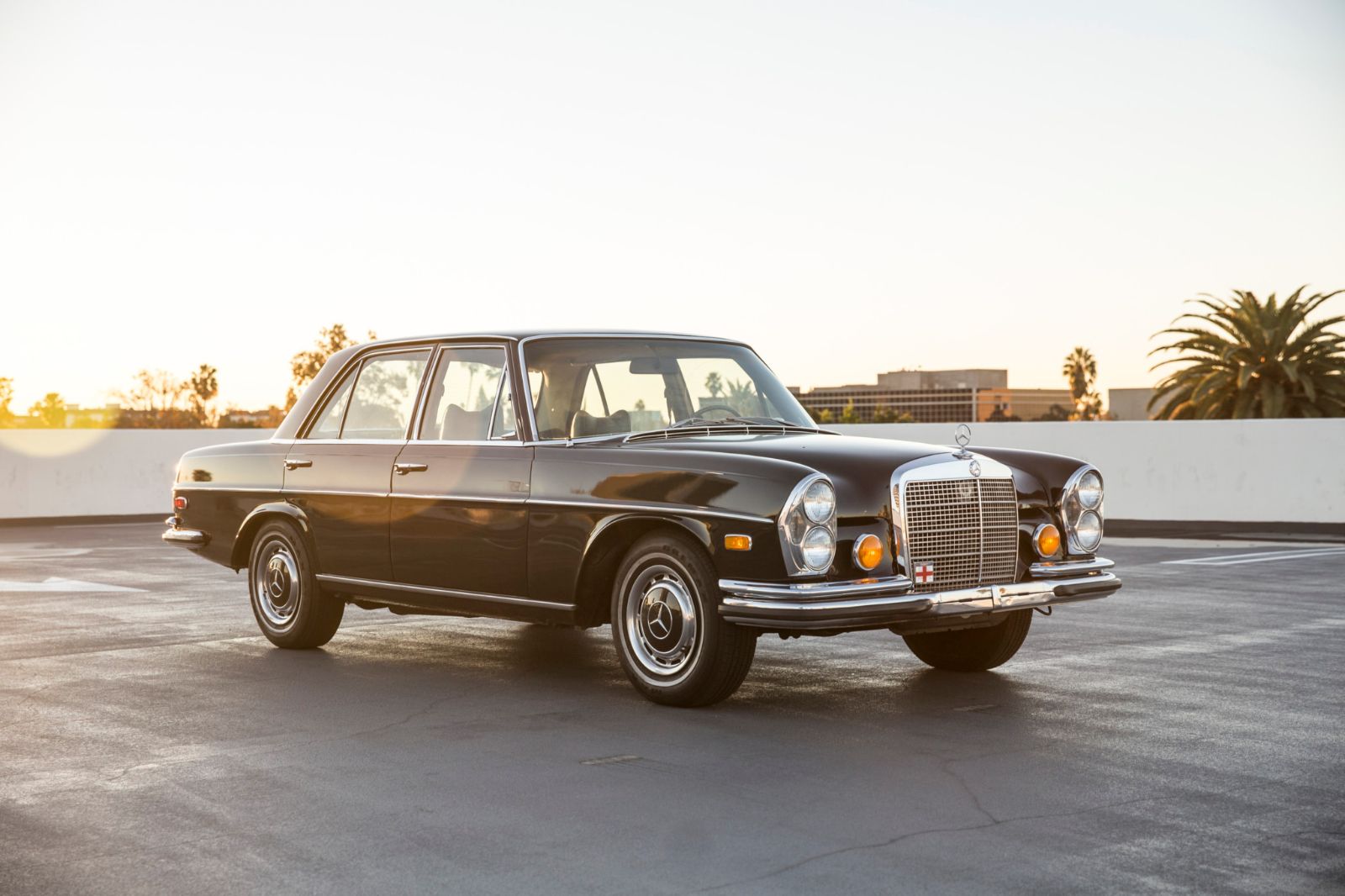
S-Class (W108/W109)
W108/W109 (1965-1972, predecessor). The Paul Bracq sedan that dropped Mercedes's tailfins (Heckflosse) for a cleaner, more refined silhouette. Officially launched before the S-Class name existed — yet the 6.3-litre V8 in the 300SEL 6.3 is widely credited as Mercedes's first true super-saloon. The benchmarks for straight-line stability and refinement were set here.
- LaunchW108/W109 launches — the precursor, 1965The Paul Bracq W108/W109 launches — the tailfins of the 1950s gone, replaced by a clean, modern full-size sedan. The S-Class name was still years away, but the 6.3-litre V8 300SEL 6.3 in 1968, often called ‘the BMW M5 of the 1960s’, is widely seen as the starting point of the Mercedes super-saloon lineage.Wikipedia (W108) ↗
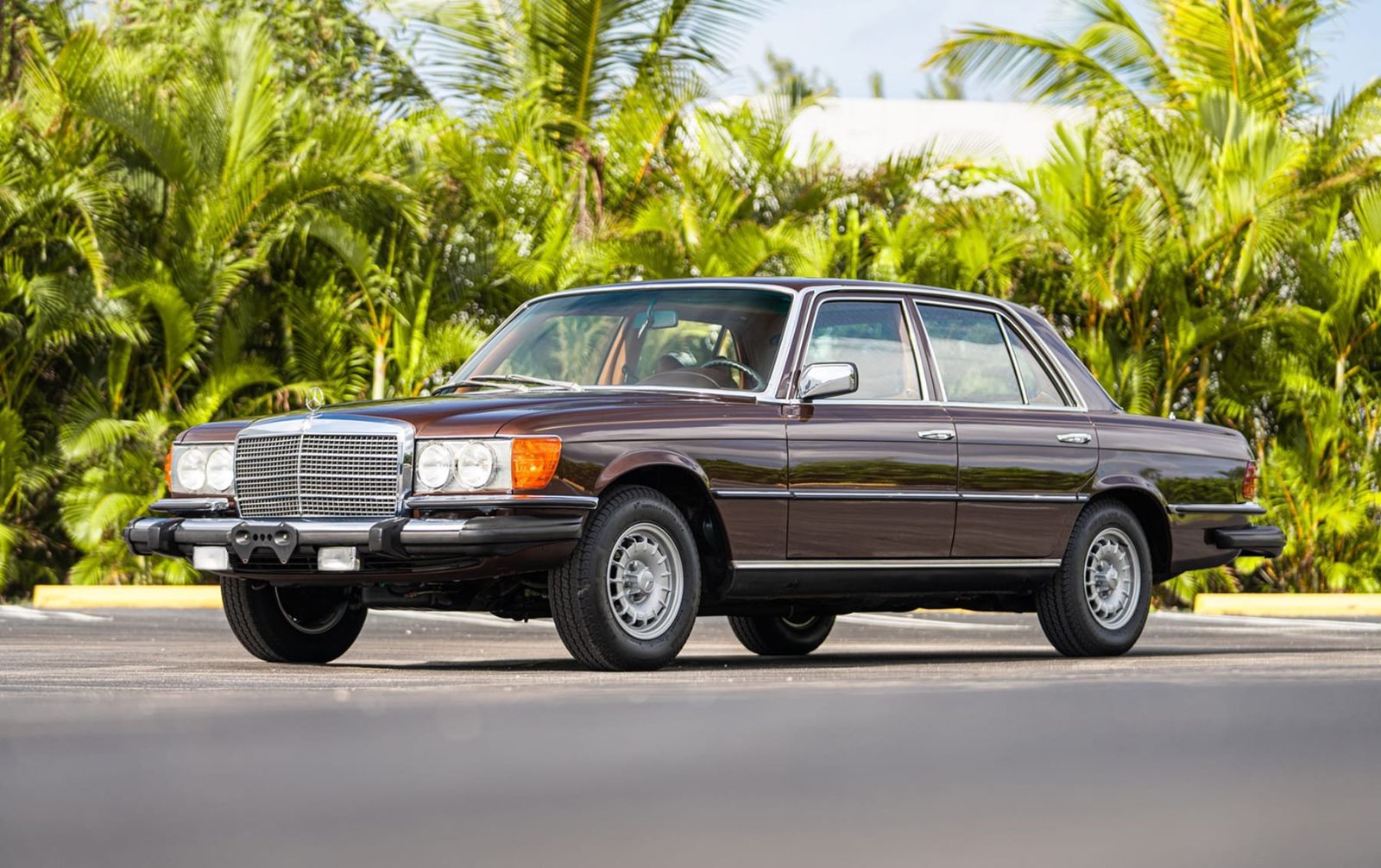
S-Class (W116)
W116 (1972-1980, the first S-Class). The first car officially called ‘S-Klasse’. Production ABS, co-developed with Bosch, arrived as a world first in 1978. The 450SEL 6.9, fitted with the 6.9-litre M100 V8, was a ‘four-door supercar’ then benchmarked directly against BMW M and Ferrari. Rear-impact structure and the collapsible steering column made crash safety mainstream.
- LaunchW116 launches — the ‘S-Klasse’ name arrives, 1972In September 1972 the W116 launched and Mercedes's full-size sedan was given the ‘S-Klasse — Sonderklasse, special class’ name for the first time. Parallel wipers, a digital clock and four-wheel disc brakes as standard. The S-Class identity built on safety and technology was set with this generation.Wikipedia (W116) ↗
- Launch450SEL 6.9 launches — the ‘four-door supercar’In 1975 the 450SEL 6.9 joined the W116 line-up. A 6.9-litre M100 V8 produced 286 hp and a 225 km/h top speed; benchmarked directly against BMW M and Ferrari GTs, with Citroën-SM-style hydropneumatic suspension that earned it the ‘four-door supercar’ tag. Only 7,380 units were built through 1979 — the rarest S-Class collector grade today.Wikipedia (450SEL 6.9) ↗
- MilestoneWorld's first production ABS — W116, 1978In 1978, Bosch-co-developed ABS appeared as an option on the W116 450SEL 6.9 — the first time anti-lock braking entered a production car. The formula was set: a new technology debuts on the S-Class, and a decade later it spreads to every car. ABS would become standard on essentially every production car by the 1990s.Mercedes-Benz Official ↗
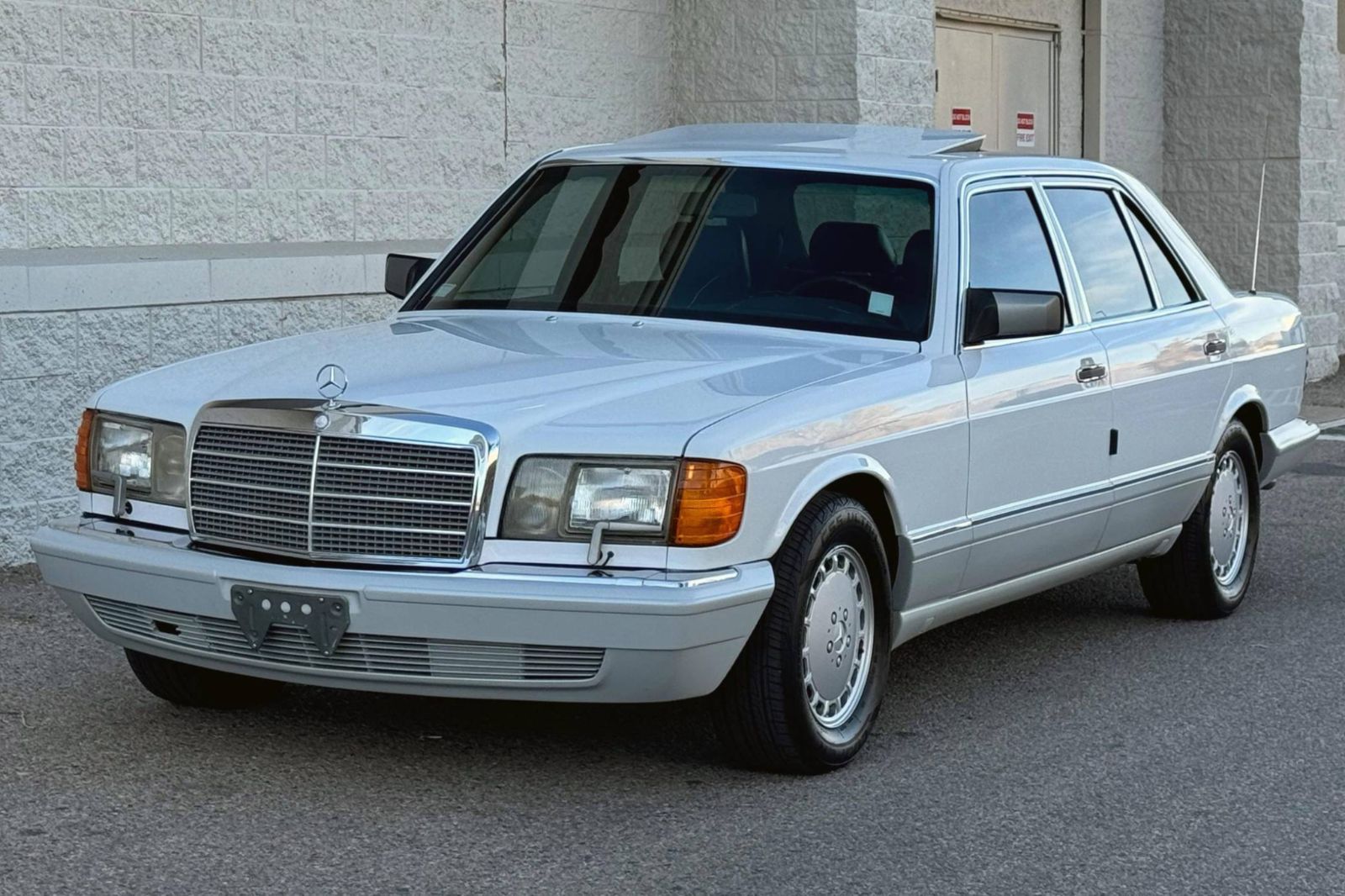
S-Class (W126)
W126 (1979-1991, the golden age). Bruno Sacco's ‘horizontale homogenität’ design — the octagonal grille, the smooth flank cladding. 893,716 units over 12 years — still the best-selling S-Class of all time. The first production driver airbag arrived in 1981, traction control (ASR) followed in 1985. Car and Driver's 1986 verdict — ‘the best-engineered car money can buy’ — is still being quoted.
- LaunchW126 launches — Bruno Sacco's ‘endless continuity’, 1979September 1979, IAA — the W126 debuts. Bruno Sacco's ‘horizontale homogenität — horizontal homogeneity’ philosophy in steel: the octagonal grille, the smooth flank cladding, proportions designed not to date. In 1984 wind-tunnel work brought the drag coefficient down to 0.36, the lowest in its class, opening a new era of efficiency in the luxury sedan.Wikipedia (W126) ↗
- MilestoneFirst production driver airbag — W126, 1981In December 1981 the W126 introduced the world's first production driver-side airbag — an option that inflated in 0.03 seconds in a crash. By 1992 it had become standard across the Mercedes range, and the move signalled the eventual standardisation of airbags across every production car.Mercedes-Benz Official ↗
- AwardCar and Driver — ‘the best-engineered car money can buy’, 1986In 1986 Car and Driver declared the W126, after a comparison test, ‘the best-engineered car money can buy’. It became the standard imported sedan of Japan's bubble-era elite, and in Korea the black W126 in Apgujeong and Cheongdam stood as the literal silhouette of power. 893,716 units over 12 years — still the best-selling S-Class ever.Wikipedia (W126) ↗
- DiscontinuedW126 ends production — 893,716 units over 12 yearsIn April 1991 the W126 ended production after 12 years and 893,716 units — a record no later S-Class generation has come close to breaking. As the successor W140 drew criticism for becoming ‘too big’, the W126's proportions and balance came to be remembered as the S-Class's golden age.Wikipedia (W126) ↗
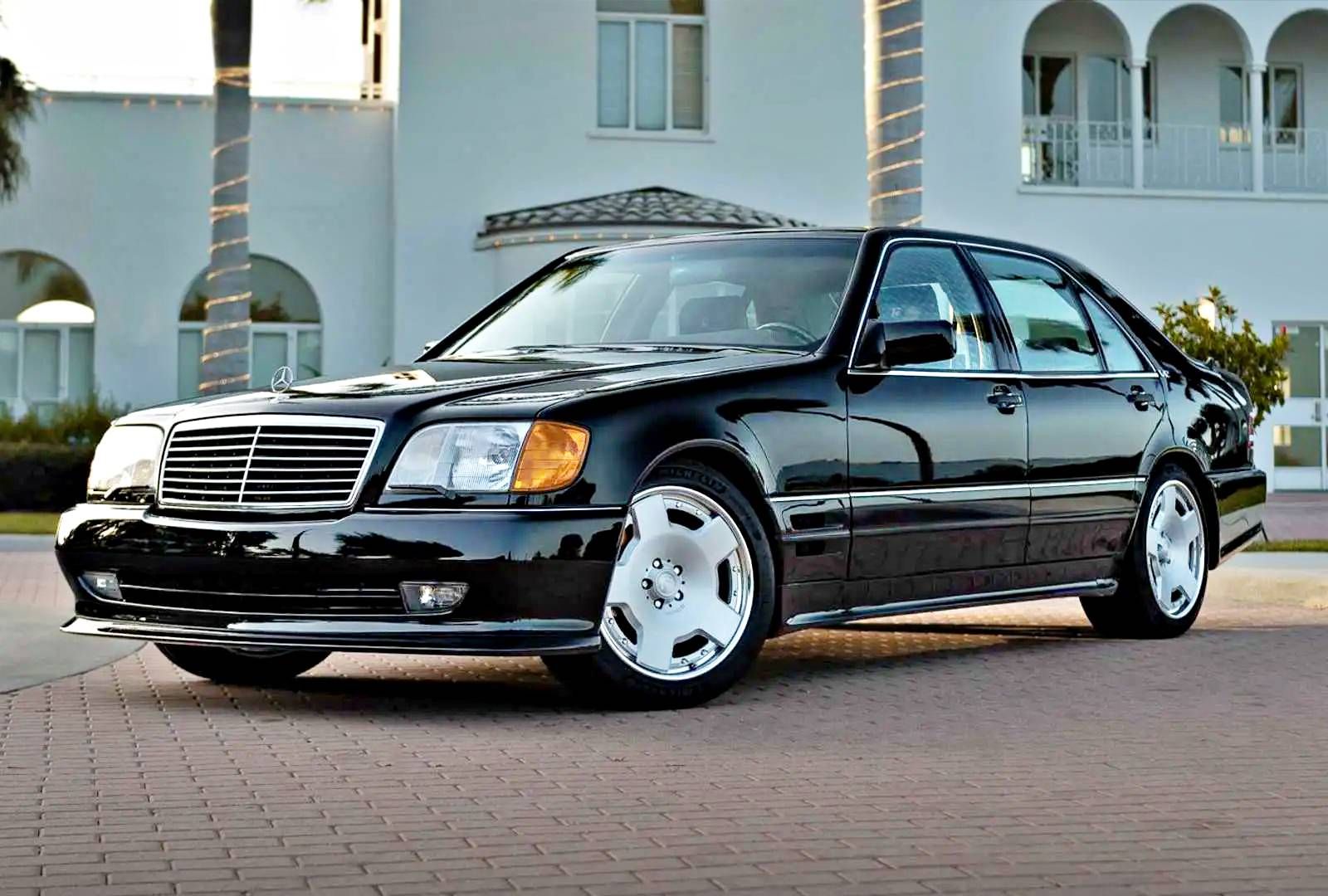
S-Class (W140)
W140 (1991-1998, the apex). The last Mercedes developed with an effectively unlimited 1980s budget. 5.1 metres long, 2.2 tonnes. The AMG V12 7.3-litre made 762 hp. Double-glazed side windows, soft-close trunk lid. The world's first production ESC arrived in 1995. CEO Werner Niefer resigned over what he called its ‘overreach’ — yet this is the generation that earned the nickname ‘the best car money can buy.’
- LaunchW140 launches — the ‘unlimited budget’ S-Class, 1991In March 1991 at Geneva, the W140 made its debut. 5.1 metres long, 2.2 tonnes, 6.0-litre V12 making 408 hp. Developed over 14 years on essentially an unlimited budget during Mercedes's 1980s peak. Double-glazed side glass, soft-close trunk, the famous rear ‘Peilstabes’ parking antennae. Yet the criticism that it had simply become too large drove CEO Werner Niefer to resign.Wikipedia (W140) ↗
- MilestoneWorld's first production ESC — W140, 1995In 1995 the W140 S600 Coupé became the first production car with ESC (Electronic Stability Control), again co-developed with Bosch. When a 1997 automotive magazine ‘elk test’ flipped the A-Class, ESC was instantly rolled out as standard across the Mercedes range, and from the late 1990s it became standard across the industry.Mercedes-Benz Official ↗
- DiscontinuedW140 ends production — the end of the ‘overreach’, 1998In March 1998 the W140 ended production after 432,732 units. Market pushback against its 2.2-tonne, 5.1-metre presence — combined with the cost pressure ahead of the DaimlerChrysler merger — forced the successor W220 onto a 270 kg diet. The era of the ‘unlimited budget’ S-Class closed here.Wikipedia (W140) ↗
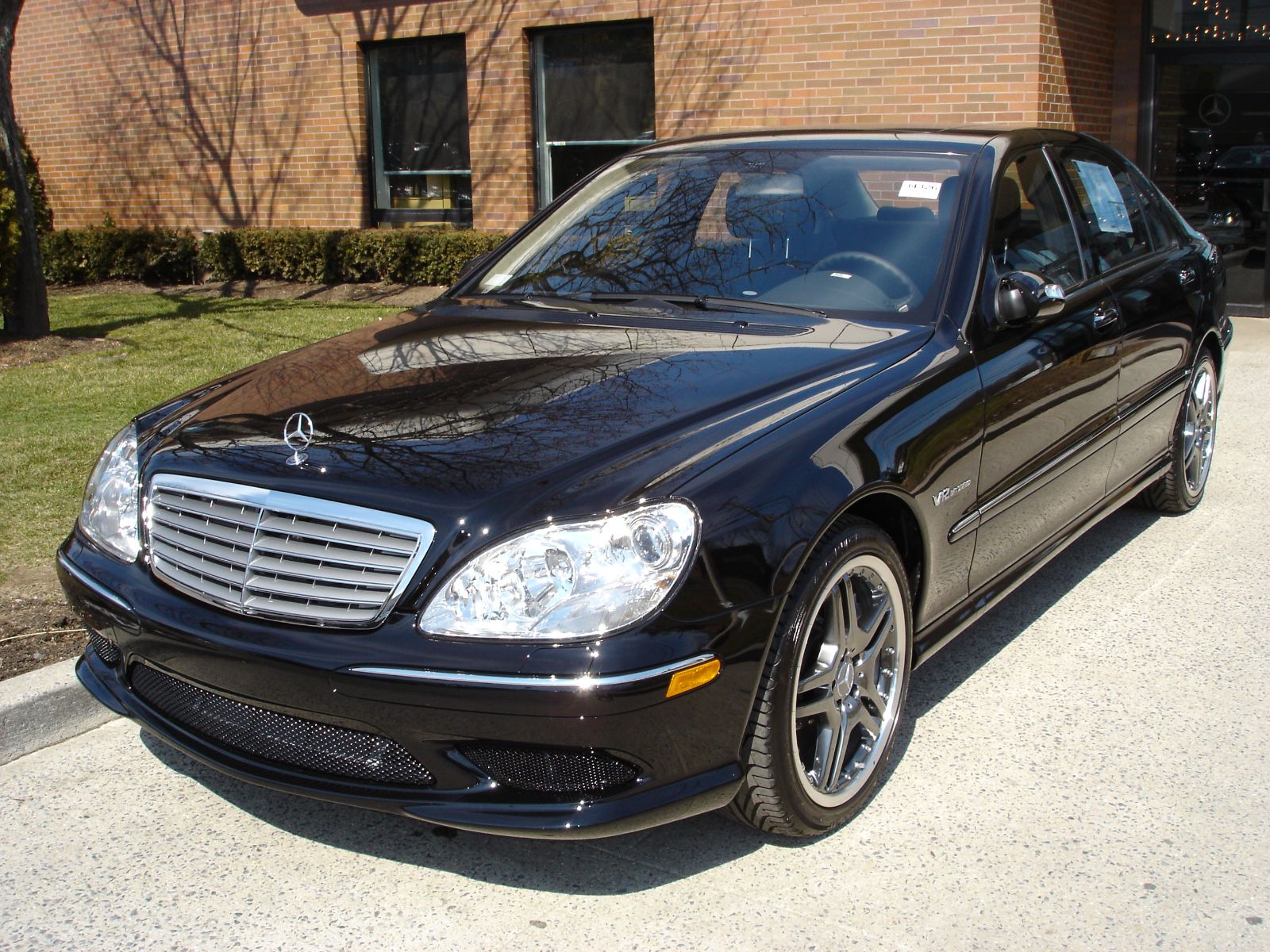
S-Class (W220)
W220 (1998-2005). The first S-Class of the DaimlerChrysler era of cost rationalisation. 70 mm shorter and 270 kg lighter than the W140. Active Body Control suspension entered production in 1998. Reclining executive seats and Keyless Go arrived. Early build issues with corrosion and electrics, however, were the first real crack in the Mercedes quality myth — and the reason the W221 that followed exists.
- LaunchW220 launches — the rationalisation era begins, 1998October 1998, Paris Motor Show — the W220 debuts. 70 mm shorter and 270 kg lighter than the W140 — and the first S-Class of the DaimlerChrysler merger era, a signal of cost rationalisation. It introduced production ABC (Active Body Control) suspension, reclining executive seats and Keyless Go. Early issues with corrosion and electrics, however, became the first dent in the Mercedes quality myth.Wikipedia (W220) ↗
- MilestoneAMG S65 arrives — the first V12 twin-turboIn 2001 the W220 AMG S65 appeared — a 6.0-litre V12 twin-turbo making 612 hp and 1,000 Nm. Where earlier AMG S-Class models had been naturally aspirated V8s and V12s, this was the car that opened the 1,000 Nm torque era. The AMG S65 V12 twin-turbo lineage carried through the W221 and W222, before ending with the W222.Wikipedia (AMG S65) ↗
- F/LW220 facelift — quality improvementsIn September 2002 the W220 received a facelift — a direct response to the early build complaints around corrosion, paint and electrics. The paint line was rebuilt and the electrical wiring redesigned. Outside, the headlamps and bumpers were refreshed. The ‘W220 = quality problems’ reputation, however, would persist until the W221 finally cleared it.Wikipedia (W220) ↗
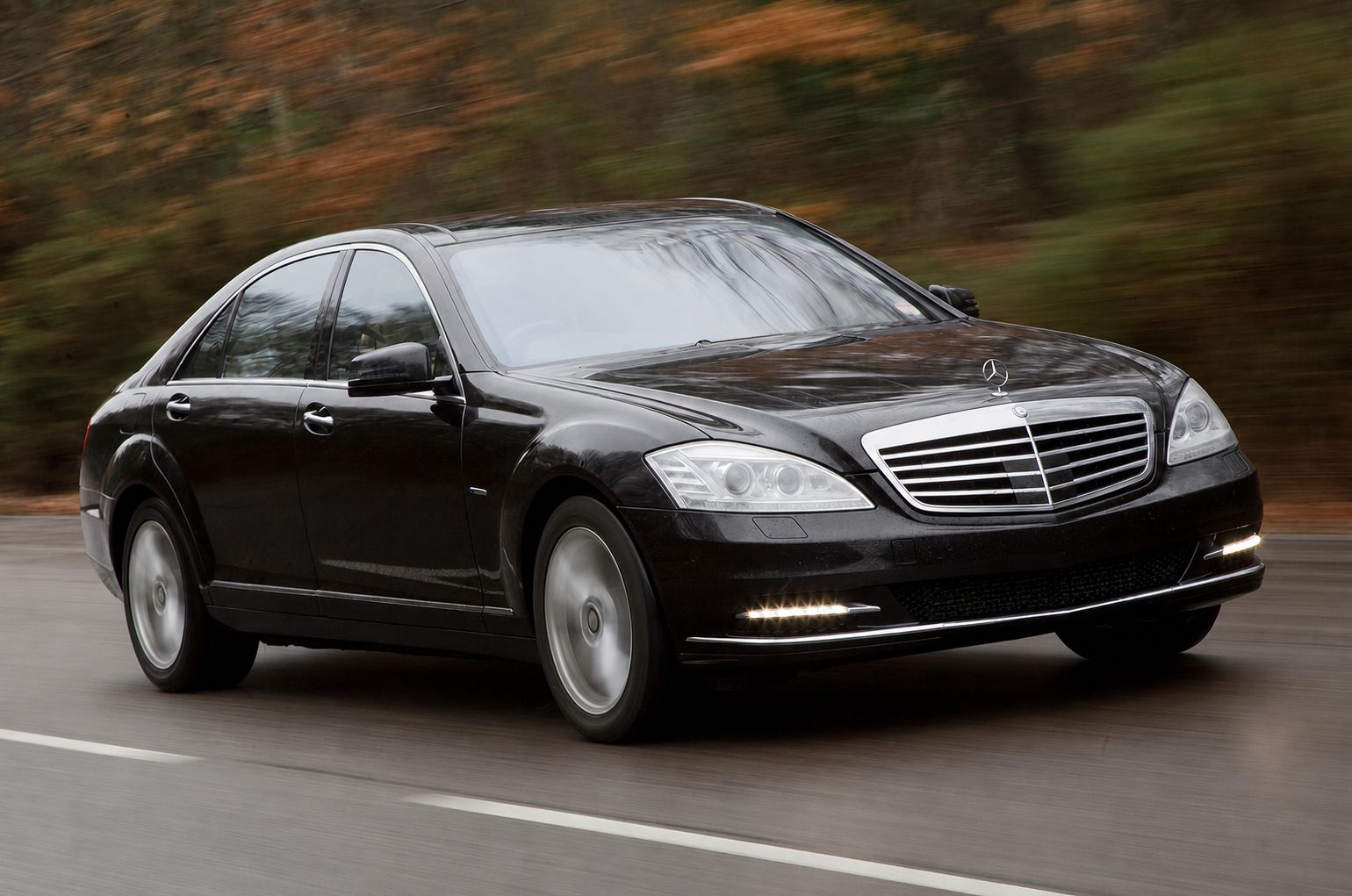
S-Class (W221)
W221 (2005-2013). The answer to the W220 quality trauma — a more settled design and restored build quality. Night View Assist debuted in production form, alongside Magic Ride (the precursor to Magic Body Control). The 2009 S400 Hybrid became Mercedes's first production hybrid. The AMG S65 made 612 hp from a twin-turbo V12.
- LaunchW221 launches — the answer to the quality crisis, 2005September 2005, Frankfurt Motor Show — the W221 debuts. The answer to the W220 quality trauma: more settled design, restored paint and electrical quality. Night View Assist arrived as a world first, and Magic Ride (the future Magic Body Control) entered production.Wikipedia (W221) ↗
- MilestoneS400 Hybrid — Mercedes's first production hybridIn 2009 the W221 S400 Hybrid launched — 3.5-litre V6 plus a 20 hp motor and lithium-ion battery. Mercedes's first production hybrid, and the brand's first lithium-ion-powered car. Fuel consumption 25 per cent below the comparable V6 — the starting point of every Mercedes hybrid that followed.Wikipedia (S400 Hybrid) ↗
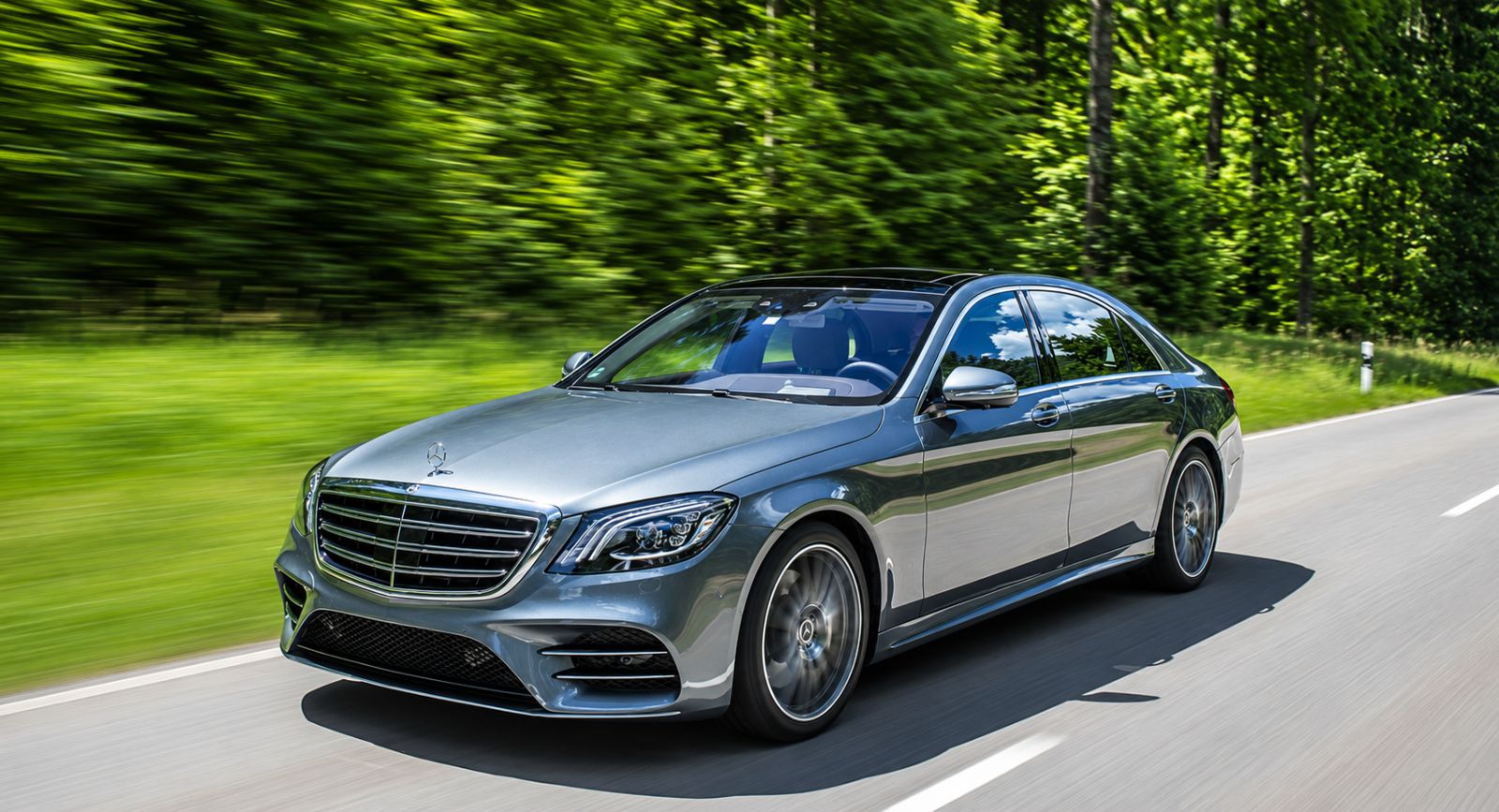
S-Class (W222)
W222 (2013-2020). The start of the digital cockpit era — twin 12.3-inch displays stretching across the dash. Magic Body Control used a stereo camera to scan the road and pre-arm the suspension, and Drive Pilot brought partial autonomy to production. The 2017 Maybach S-Class arrived as a ‘Maybach’ sub-brand, laying the groundwork for the W223 to split it out as a separate model.
- LaunchW222 launches — the digital cockpit era, 2013May 2013, Hamburg — the W222 unveiled. The first production car with a digital cockpit defined by twin 12.3-inch displays. Magic Body Control used a stereo camera to scan the road ahead and pre-arm the suspension; Drive Pilot brought partial autonomy to production. ‘A car that just follows the one in front’ became a production reality.Wikipedia (W222) ↗
- AwardWorld Car of the Year 2014 — W222In 2014 the W222 won World Car of the Year, with the digital cockpit and Magic Body Control cited as the decisive factors. Two decades after Car and Driver's ‘best car money can buy’ verdict on its predecessor, the S-Class reclaimed its position as the world's benchmark sedan.World Car Awards ↗
- MilestoneMaybach S-Class — the standalone sub-brand, 2017In 2017 the W222 Maybach S-Class arrived. 200 mm longer wheelbase, 6.0-litre V12 twin-turbo making 630 hp. After the original Maybach (57 and 62) failed as a standalone brand, ‘Mercedes-Maybach’ returned as a sub-brand inside the S-Class. With the W223, the Maybach S-Class (Z223) would later split off entirely as a separate model.Mercedes-Benz Official ↗
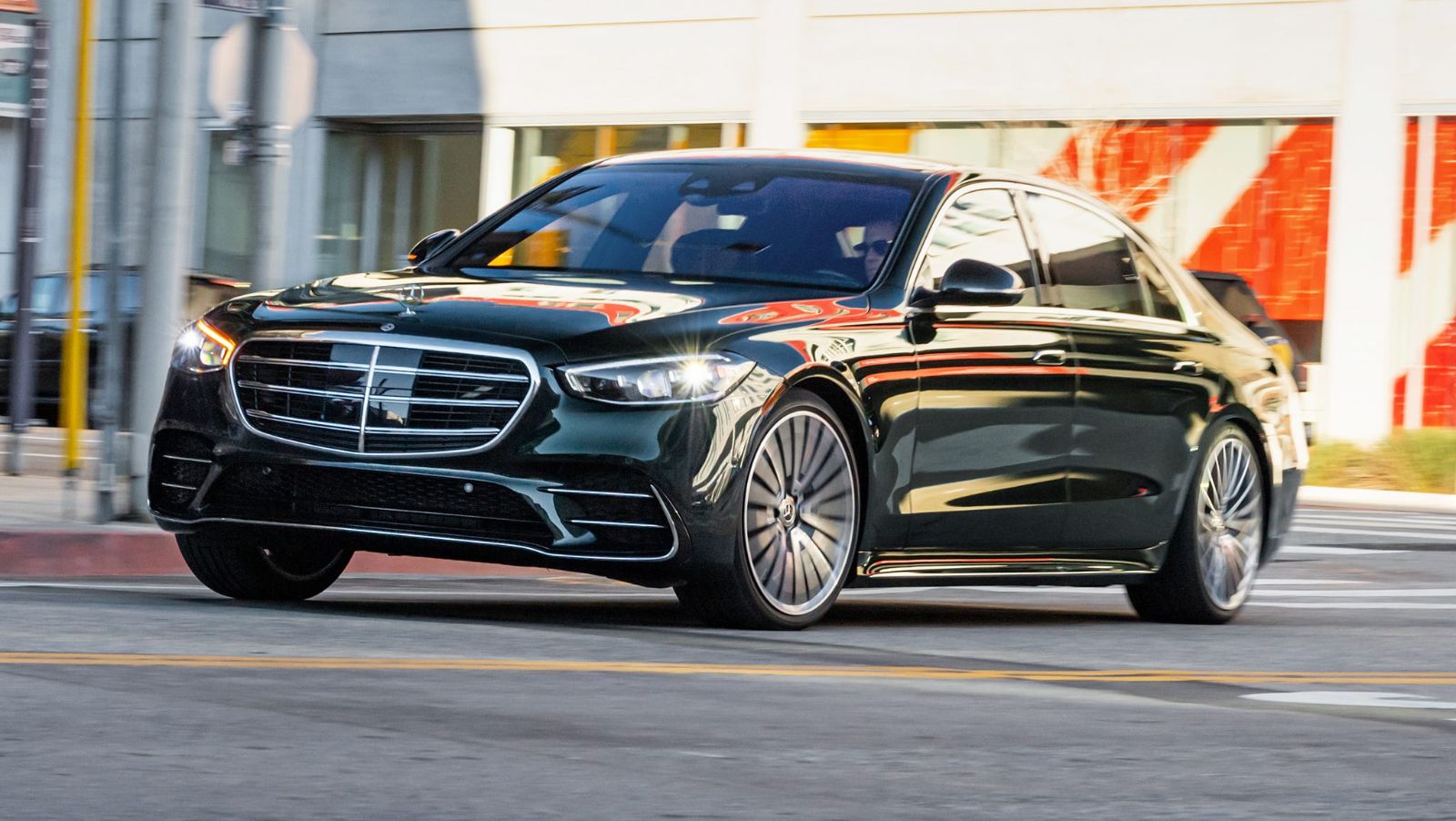
S-Class
W223 (2020-, current). MBUX 3D plus an optional 28-inch OLED, in-car 5G, an AR head-up display, and up to 10 degrees of rear-wheel steering. In 2021 the Maybach S-Class was spun off as the standalone Z223. The 2026 W223 facelift integrates ChatGPT and Microsoft cloud services. Alongside the EQS, this generation holds one half of the ICE/EV flagship pair.
- LaunchW223 unveiled — 28-inch OLED, 10-degree rear-wheel steering, 2020On 2 September 2020, the W223 made its debut as a digital world premiere. MBUX 3D combined a twin 12.3 + 12.8-inch driver display with a 28-inch OLED for the centre and passenger sides, in-car 5G and an AR head-up display. Rear-wheel steering up to 10 degrees cut the urban turning radius by 2 metres. Because of COVID-19, it was the first S-Class to debut at a digital event rather than a motor show.Mercedes-Benz Official ↗
- MilestoneMaybach S-Class (Z223) splits off as a standalone model, 2021In 2021 the Maybach S-Class split off from the W223 as the Z223 — a separate model with its own body engineering, trim and seats. In Korea the Maybach S680 (6.0-litre V12 twin-turbo) launched at roughly 350 million won and set a new benchmark for the ultra-luxury market.Mercedes-Benz Official ↗
Full Evolution
- LaunchW108-W109
W108/W109 launches — the precursor, 1965
The Paul Bracq W108/W109 launches — the tailfins of the 1950s gone, replaced by a clean, modern full-size sedan. The S-Class name was still years away, but the 6.3-litre V8 300SEL 6.3 in 1968, often called ‘the BMW M5 of the 1960s’, is widely seen as the starting point of the Mercedes super-saloon lineage.
- LaunchW116
W116 launches — the ‘S-Klasse’ name arrives, 1972
In September 1972 the W116 launched and Mercedes's full-size sedan was given the ‘S-Klasse — Sonderklasse, special class’ name for the first time. Parallel wipers, a digital clock and four-wheel disc brakes as standard. The S-Class identity built on safety and technology was set with this generation.
- LaunchW116
450SEL 6.9 launches — the ‘four-door supercar’
In 1975 the 450SEL 6.9 joined the W116 line-up. A 6.9-litre M100 V8 produced 286 hp and a 225 km/h top speed; benchmarked directly against BMW M and Ferrari GTs, with Citroën-SM-style hydropneumatic suspension that earned it the ‘four-door supercar’ tag. Only 7,380 units were built through 1979 — the rarest S-Class collector grade today.
- MilestoneW116
World's first production ABS — W116, 1978
In 1978, Bosch-co-developed ABS appeared as an option on the W116 450SEL 6.9 — the first time anti-lock braking entered a production car. The formula was set: a new technology debuts on the S-Class, and a decade later it spreads to every car. ABS would become standard on essentially every production car by the 1990s.
- LaunchW126
W126 launches — Bruno Sacco's ‘endless continuity’, 1979
September 1979, IAA — the W126 debuts. Bruno Sacco's ‘horizontale homogenität — horizontal homogeneity’ philosophy in steel: the octagonal grille, the smooth flank cladding, proportions designed not to date. In 1984 wind-tunnel work brought the drag coefficient down to 0.36, the lowest in its class, opening a new era of efficiency in the luxury sedan.
- MilestoneW126
First production driver airbag — W126, 1981
In December 1981 the W126 introduced the world's first production driver-side airbag — an option that inflated in 0.03 seconds in a crash. By 1992 it had become standard across the Mercedes range, and the move signalled the eventual standardisation of airbags across every production car.
- AwardW126
Car and Driver — ‘the best-engineered car money can buy’, 1986
In 1986 Car and Driver declared the W126, after a comparison test, ‘the best-engineered car money can buy’. It became the standard imported sedan of Japan's bubble-era elite, and in Korea the black W126 in Apgujeong and Cheongdam stood as the literal silhouette of power. 893,716 units over 12 years — still the best-selling S-Class ever.
- LaunchW140
W140 launches — the ‘unlimited budget’ S-Class, 1991
In March 1991 at Geneva, the W140 made its debut. 5.1 metres long, 2.2 tonnes, 6.0-litre V12 making 408 hp. Developed over 14 years on essentially an unlimited budget during Mercedes's 1980s peak. Double-glazed side glass, soft-close trunk, the famous rear ‘Peilstabes’ parking antennae. Yet the criticism that it had simply become too large drove CEO Werner Niefer to resign.
- DiscontinuedW126
W126 ends production — 893,716 units over 12 years
In April 1991 the W126 ended production after 12 years and 893,716 units — a record no later S-Class generation has come close to breaking. As the successor W140 drew criticism for becoming ‘too big’, the W126's proportions and balance came to be remembered as the S-Class's golden age.
- MilestoneW140
World's first production ESC — W140, 1995
In 1995 the W140 S600 Coupé became the first production car with ESC (Electronic Stability Control), again co-developed with Bosch. When a 1997 automotive magazine ‘elk test’ flipped the A-Class, ESC was instantly rolled out as standard across the Mercedes range, and from the late 1990s it became standard across the industry.
- DiscontinuedW140
W140 ends production — the end of the ‘overreach’, 1998
In March 1998 the W140 ended production after 432,732 units. Market pushback against its 2.2-tonne, 5.1-metre presence — combined with the cost pressure ahead of the DaimlerChrysler merger — forced the successor W220 onto a 270 kg diet. The era of the ‘unlimited budget’ S-Class closed here.
- LaunchW220
W220 launches — the rationalisation era begins, 1998
October 1998, Paris Motor Show — the W220 debuts. 70 mm shorter and 270 kg lighter than the W140 — and the first S-Class of the DaimlerChrysler merger era, a signal of cost rationalisation. It introduced production ABC (Active Body Control) suspension, reclining executive seats and Keyless Go. Early issues with corrosion and electrics, however, became the first dent in the Mercedes quality myth.
- MilestoneW220
AMG S65 arrives — the first V12 twin-turbo
In 2001 the W220 AMG S65 appeared — a 6.0-litre V12 twin-turbo making 612 hp and 1,000 Nm. Where earlier AMG S-Class models had been naturally aspirated V8s and V12s, this was the car that opened the 1,000 Nm torque era. The AMG S65 V12 twin-turbo lineage carried through the W221 and W222, before ending with the W222.
- F/LW220
W220 facelift — quality improvements
In September 2002 the W220 received a facelift — a direct response to the early build complaints around corrosion, paint and electrics. The paint line was rebuilt and the electrical wiring redesigned. Outside, the headlamps and bumpers were refreshed. The ‘W220 = quality problems’ reputation, however, would persist until the W221 finally cleared it.
- LaunchW221
W221 launches — the answer to the quality crisis, 2005
September 2005, Frankfurt Motor Show — the W221 debuts. The answer to the W220 quality trauma: more settled design, restored paint and electrical quality. Night View Assist arrived as a world first, and Magic Ride (the future Magic Body Control) entered production.
- MilestoneW221
S400 Hybrid — Mercedes's first production hybrid
In 2009 the W221 S400 Hybrid launched — 3.5-litre V6 plus a 20 hp motor and lithium-ion battery. Mercedes's first production hybrid, and the brand's first lithium-ion-powered car. Fuel consumption 25 per cent below the comparable V6 — the starting point of every Mercedes hybrid that followed.
- LaunchW222
W222 launches — the digital cockpit era, 2013
May 2013, Hamburg — the W222 unveiled. The first production car with a digital cockpit defined by twin 12.3-inch displays. Magic Body Control used a stereo camera to scan the road ahead and pre-arm the suspension; Drive Pilot brought partial autonomy to production. ‘A car that just follows the one in front’ became a production reality.
- AwardW222
World Car of the Year 2014 — W222
In 2014 the W222 won World Car of the Year, with the digital cockpit and Magic Body Control cited as the decisive factors. Two decades after Car and Driver's ‘best car money can buy’ verdict on its predecessor, the S-Class reclaimed its position as the world's benchmark sedan.
- MilestoneW222
Maybach S-Class — the standalone sub-brand, 2017
In 2017 the W222 Maybach S-Class arrived. 200 mm longer wheelbase, 6.0-litre V12 twin-turbo making 630 hp. After the original Maybach (57 and 62) failed as a standalone brand, ‘Mercedes-Maybach’ returned as a sub-brand inside the S-Class. With the W223, the Maybach S-Class (Z223) would later split off entirely as a separate model.
- LaunchW223
W223 unveiled — 28-inch OLED, 10-degree rear-wheel steering, 2020
On 2 September 2020, the W223 made its debut as a digital world premiere. MBUX 3D combined a twin 12.3 + 12.8-inch driver display with a 28-inch OLED for the centre and passenger sides, in-car 5G and an AR head-up display. Rear-wheel steering up to 10 degrees cut the urban turning radius by 2 metres. Because of COVID-19, it was the first S-Class to debut at a digital event rather than a motor show.
- Milestone
EQS unveiled — the ICE/EV two-track flagship era begins
In 2021 the EQS was unveiled, positioned as the S-Class's EV sibling but sharing its platform, suspension and MBUX 3D core technology. From that moment on, Mercedes's flagship was split into two tracks — the S-Class as ICE/hybrid and the EQS as pure BEV.
- MilestoneW223
Maybach S-Class (Z223) splits off as a standalone model, 2021
In 2021 the Maybach S-Class split off from the W223 as the Z223 — a separate model with its own body engineering, trim and seats. In Korea the Maybach S680 (6.0-litre V12 twin-turbo) launched at roughly 350 million won and set a new benchmark for the ultra-luxury market.
- F/L
W223 facelift — ChatGPT integration, 2026
In 2026 the W223 facelift launches. MBUX now integrates with ChatGPT and Microsoft cloud services, enabling natural-language voice dialogue. Headlamps and grille are refreshed. In Korea the S580 4MATIC carries an MSRP of around 230 million won. Even in the EV era, the V8 twin-turbo mild-hybrid keeps the ICE flagship seat warm.
Other Heritage
Explore other model histories in this category.